Roofing adviceUpdated 27 November 2026
Your chimney stack: what to check from the ground before winter
A chimney stack is the most exposed brickwork on a house, so it usually shows wear first. From the ground, with a pair of binoculars, look for six things: a cracked or loose pot, cracked flaunching (the mortar around the pot), plants growing out of the stack, eroded joints or broken bricks, a stack that leans, and a damp patch near the chimney breast indoors.
Winter is when small faults turn into leaks: frost does most damage to brickwork that is already wet, so a stack that lets water in gets worse quickly. This guide goes through each sign, what it means and whether it can wait, with a chimney we rebuilt for a customer as the worked example.
Key facts
- Written by
- RJR Home Improvements
- Published
- 27 November 2026
- Check from
- The ground, with binoculars
- Never
- Climb up yourself
- 07542 373810
Sign 1
Is the pot cracked, leaning or loose?
A cracked pot lets water into the flue, and a loose one can come down in the next storm. Look at each pot with binoculars from the street and from the garden.
- Cadw, the Welsh heritage service, advises checking pots with binoculars and replacing broken ones. Its guidance is written for older buildings, but the check is the same on any house.
- The Society for the Protection of Ancient Buildings (SPAB) notes that pots work loose when the flaunching around them breaks down.
- If a pot is leaning over a path, a drive or a neighbour’s garden, keep people away from below it and get it seen to before the next high wind.
Sign 2
Is the flaunching cracked?
Flaunching is the sloped mortar cap on top of the stack that holds the pots and throws rain off. Once it cracks, water runs straight down into the brickwork.
It is hard to see from the street. Cadw suggests looking from higher ground or a neighbouring building if you can. Cracks, missing chunks or a pot sitting at an angle all point to flaunching that needs renewing. When we renew it, we form a fresh slope so water runs off rather than sitting on the stack.
Sign 3
Is anything growing out of it?
Moss, grass or a small shrub on a chimney is more than untidy. Roots need a gap to grow in, so plants are often the first sign the mortar has worn away.
SPAB says weed growth at the top of a stack can show the mortar is eroding, and Cadw advises removing plants as early as possible because roots push the joints apart. Pulling a plant out from a ladder is not a safe job: it needs scaffold or a roof ladder and someone used to working at height.
Sign 4
Are the joints worn or bricks missing?
Worn joints look like dark gaps between the bricks, deepest at the top of the stack. Missing or crumbling bricks mean water has been getting in for a while.
SPAB notes that joints weather fastest at the top of the stack, on the side facing the prevailing wind, and just below the roofline. Eroded mortar can cause damp and make the stack unstable. Repointing early is the cheaper fix: leave it, and the top courses may need rebuilding.
Sign 5
Does the stack lean or have a crack running up it?
Compare the stack with the walls of the house, or with your neighbour’s. A stack that leans, bows or has a crack running up it needs a roofer to look at it soon.
Cadw’s advice is to compare it with the last time you looked: if a stack has changed, it may need stabilising or rebuilding. If it leans towards a path or a neighbour’s property, treat it as urgent and keep the area below it clear.
Sign 6
Is there a damp patch near the chimney breast?
A brown stain on the ceiling or wall next to the chimney breast, especially after rain, usually means water is getting in at the stack or at the flashing where it meets the roof.
Cadw calls poor flashing around chimneys one of the most common ways water gets into a home. Our leadwork page shows how flashing is fitted, and roof leak repairs explains how to tell a leak from condensation.
Worked example
What did we find on a real chimney?
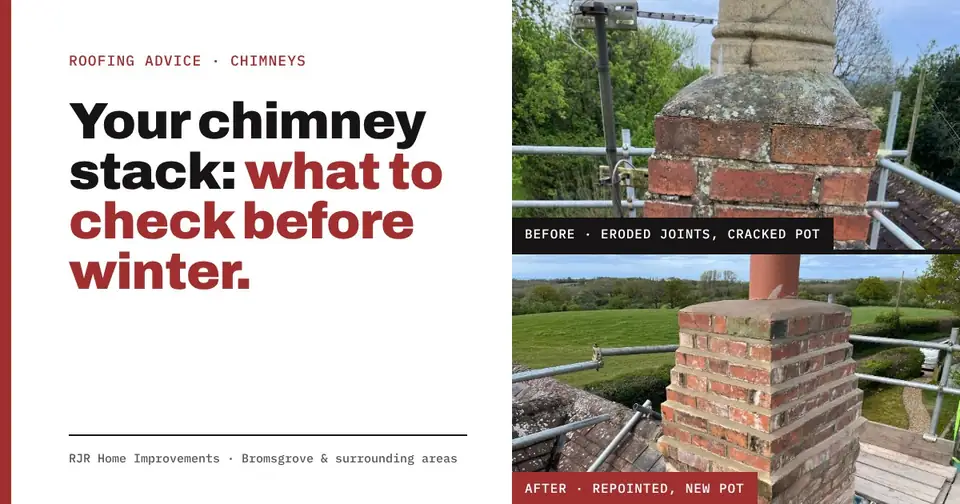
The stack in the photo at the top of this page had most of these signs at once. Before: eroded mortar joints, displaced bricks, lichen, a metal strap band round the stack and a cracked stone pot. A redundant TV aerial bracket was still fixed to the side.
We rebuilt the top courses, repointed the stack, laid new flaunching and fitted a new terracotta pot. SPAB recommends taking redundant aerials and fixings off, because they corrode and damage the brickwork. The full job is on our chimney repairs page.
What can wait
What needs doing now, and what can wait until spring?
- Now: a loose or leaning pot, a leaning or split stack, or water coming in. These get worse in wind and frost.
- Before the worst weather if you can: cracked flaunching and badly worn joints at the top of the stack.
- Can usually wait for drier weather: light moss, small patches of worn pointing lower down, and an aerial bracket that is no longer used, as long as nothing is loose.
Send us a photo taken from the ground and your postcode, and we’ll tell you which of these you’re looking at. Please don’t go up a ladder to take it.
Sources
Sources.
- Cadw: Chimneys (maintenance guidance)
- SPAB: Chimney maintenance
- RICS isurv: Attention and upkeep, chimney maintenance
Each source was read on 27 November 2026. If anything here has changed, the source wins.
Something wrong with the chimney? Send us a photo.
Fill this in and it opens WhatsApp with everything written for you. Add your photos, press send, and we’ll come back to you. Quotes are free, with no obligation.
07542 373810Prefer to type it yourself? Open WhatsApp directly.